How your client’s search behavior changed with AI
+50% of US consumers now use AI to find local businesses. See how search behavior changed with ChatGPT and Google AI, and what it means for your bookings.



Written by the SEO and GEO Manager at GlossGenius.
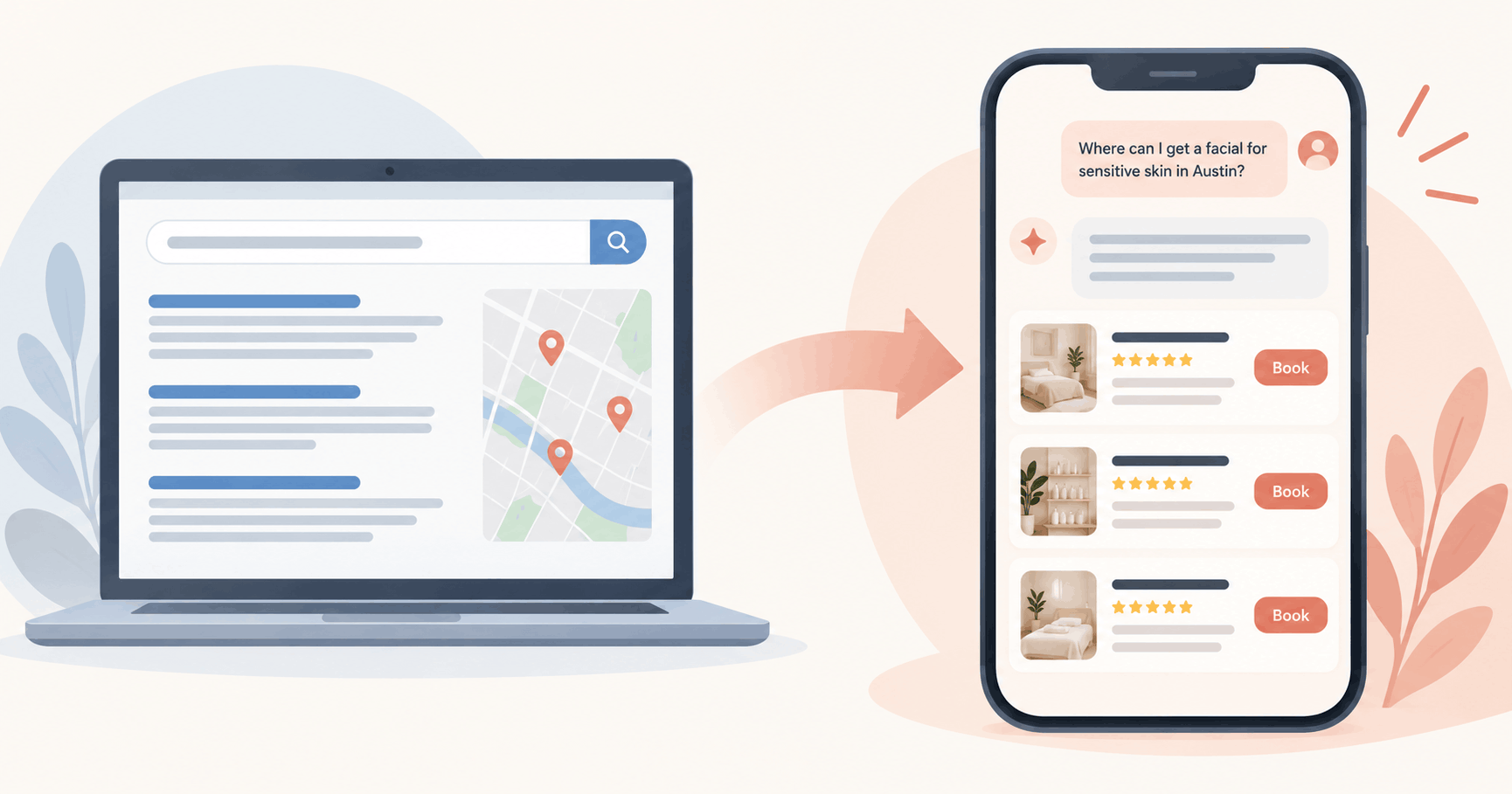
Before AI-assisted search, your clients mainly used Google and other search engines to find local businesses. They entered a search and received a list of results with links they could click. Local searches also included a map (called a local pack) showing nearby businesses.
With AI, your clients can ask a question in an assistant like ChatGPT and receive a generated answer with suggested businesses. They can then ask follow-up questions to compare their options. It is important to understand how your clients use AI to find your business because ChatGPT’s audience is broadening: OpenAI found that message volume grew across all age groups in the first quarter of 2026, with consumers over 35 accounting for an increasing share.
The most important difference is that your clients can skip part of the research they previously did themselves. AI selects which businesses to include and what information to highlight. Consumers may still check websites and reviews, but they can start with a shortlist prepared by the AI.
Let’s look at how this changes the way potential clients search for appointment and service businesses.
More potential clients are using AI to discover local appointment and service businesses
SOCi found that 52% of U.S. consumers reported using AI to find a local business in the previous 30 days in 2026, up from 9% in 2025. Separately, BrightLocal found that 45% used AI for local recommendations in the preceding year. AI answers are becoming another place where prospective clients may first encounter your business.
People may get information about local businesses without visiting a website
Pew Research Center observed clicks on traditional Google results in 8% of visits with an AI summary, compared with 15% without one. Although the study covered all search categories, it suggests that AI answers can influence what people learn before they reach a business’s website.
Customers still check AI recommendations
BrightLocal found that 43% of people who started their latest local-business search with AI subsequently checked Google. Across all respondents, 71% used Google Search during that journey. For business owners, this suggests that reviews, accurate business information, and a clear website still help prospective clients evaluate a recommendation and decide whom to contact.
Let’s compare traditional-search and AI-assisted behaviors.
Traditional search vs search with ChatGPT and Google AI overview
AI can help your clients build a shortlist before they visit individual business websites. Your clients may still check reviews, confirm details, and make the final choice themselves.
Simon Buret de Longagne, SEO and GEO Manager at GlossGenius.
We recreated a client journey looking for a service appointment business and we learned the following:
AI changes where clients do their research and how much they know before visiting a business’s website.
Our test shows that:
1. The client starts with a shortlist selected by AI
Both answers presented five businesses. ChatGPT included a map, while Google added a comparison table and Maps results. The client’s initial options—and first impression of those businesses—come from the information the AI chooses to present.
2. Clients can research a business before opening its website
The business panel, service descriptions, and follow-up answers let clients learn about a business within the AI experience. Someone who eventually visits the website may already have a particular business and treatment in mind.
3. Clients can be ready to book before visiting your website
A client can discover a business, explore its services, and consider a treatment—all within ChatGPT. They may gather everything they need to decide before clicking the Call button or opening the website to book. At that stage, the website may simply be where they complete the booking.
4. Clients can leave the AI conversation when it stops helping and use other search engines
In the illustrated Google journey, the lengthy response prompted you to visit the website. That is a useful observation: clients can move between AI and websites according to which helps them find the information they need. Google also provides an entry into conversational search from its existing results, without requiring the client to start in ChatGPT.
Our takeaway: AI can help clients discover businesses, narrow their choices, and explore services. The next step still depends on what they need—another answer, a website visit, or a phone call.
Test: searching for “best medical spa in austin texas”
Let’s look at the results in ChatGPT and Google AI Overview, then follow the steps a potential customer might take.
Client search behavior using ChatGPT to find a local appointment business
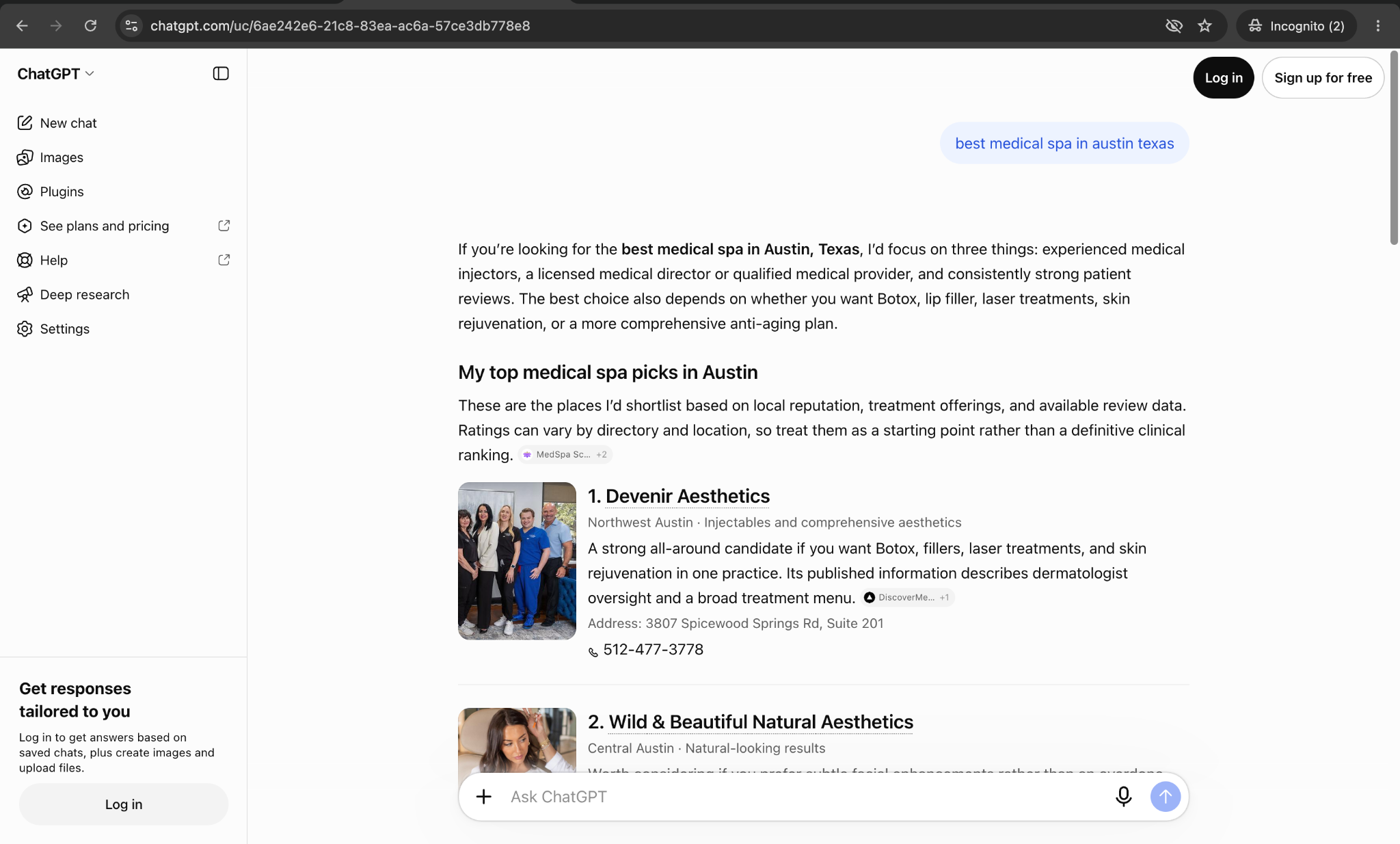
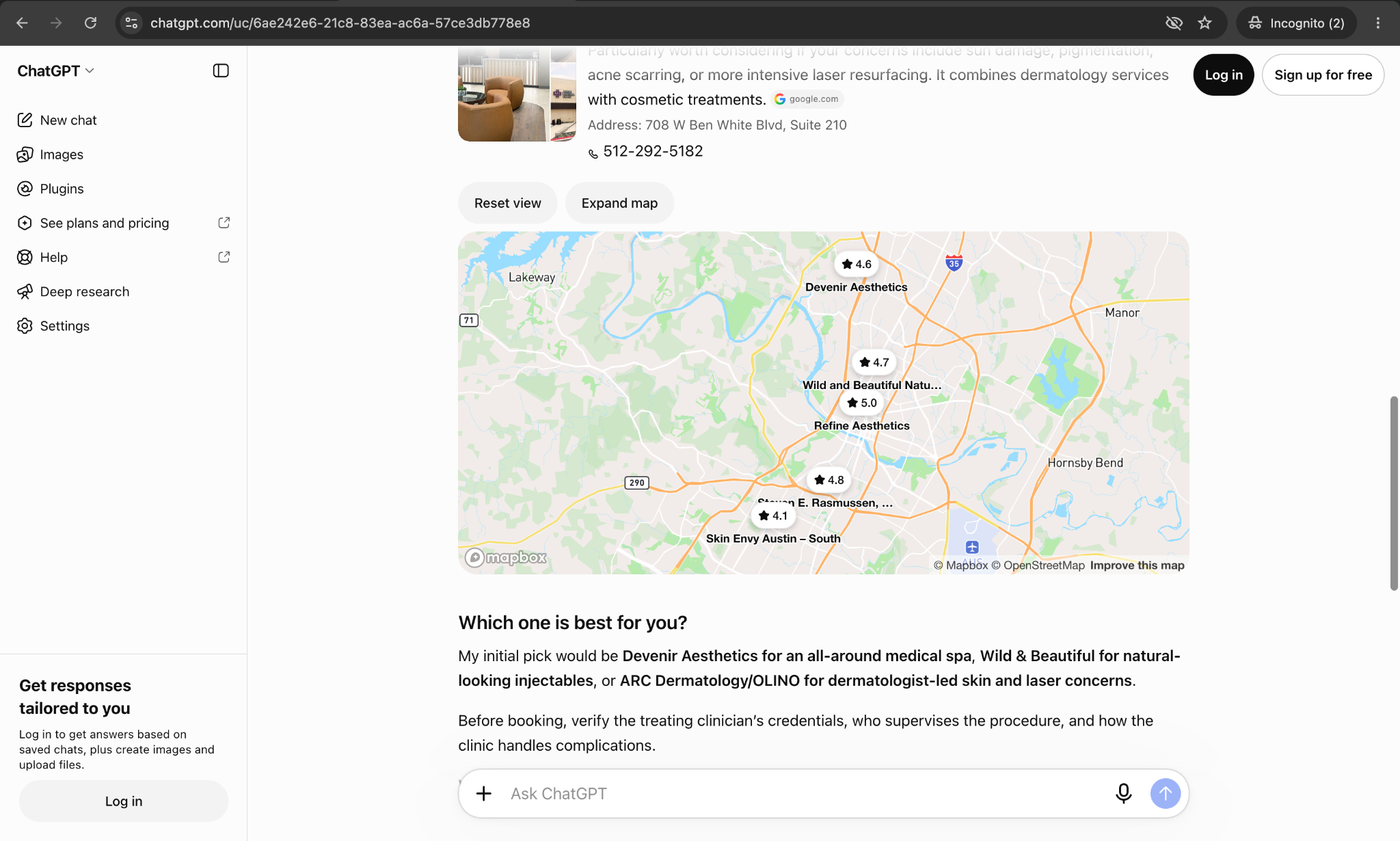
ChatGPT lists 5 businesses and includes a map showing the businesses it recommends.
Opening a business’s details
When we click the first result, a popup opens with more information about the business.
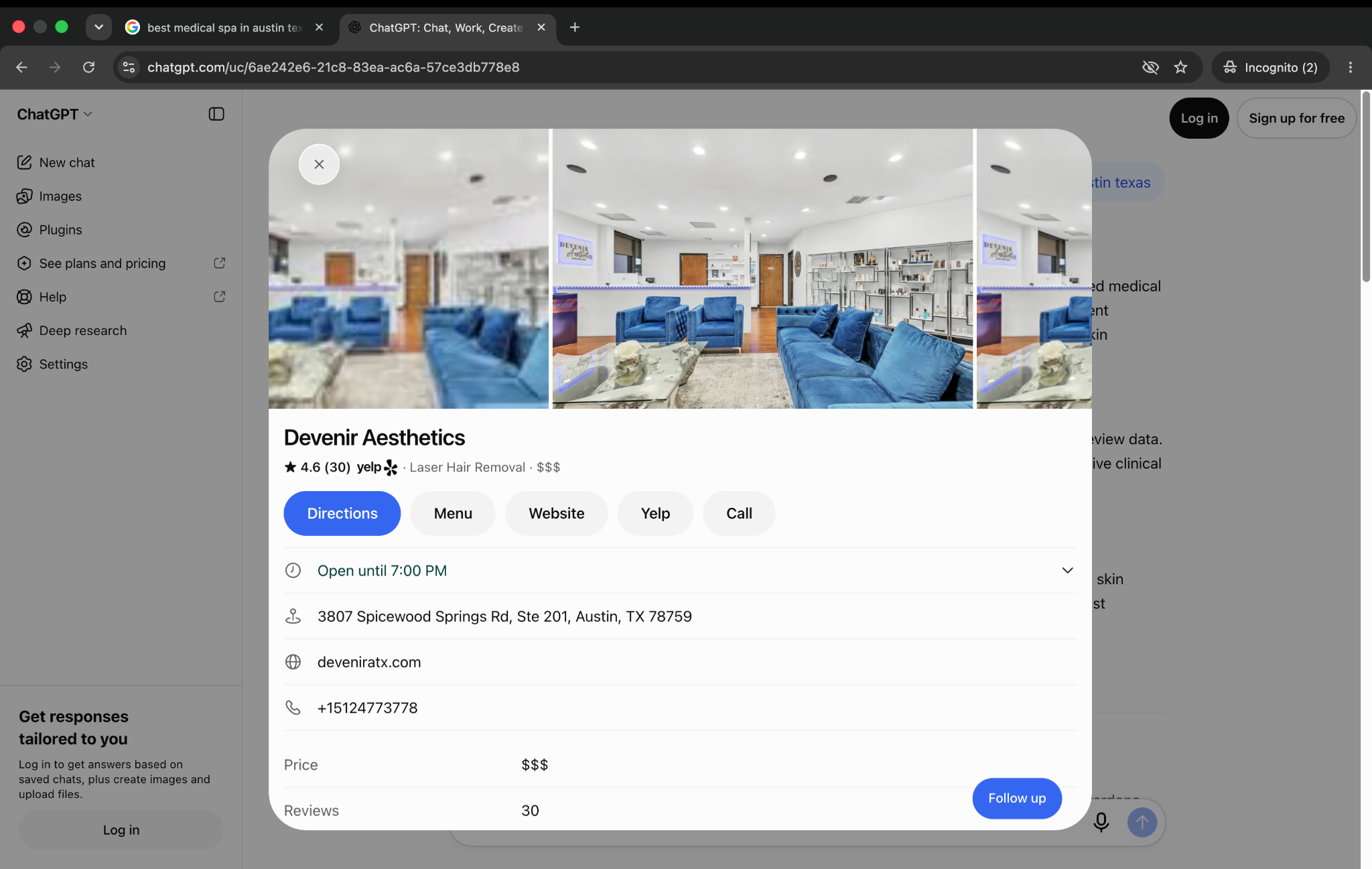
A year ago, this would have been a link taking me to the business’s website. Over the past year, ChatGPT has expanded the information available within the chat, allowing me to learn more before leaving it.
The popup includes several buttons:
- Website links take me to the business’s website.
- Call lets me call the business directly from my phone.
- Follow up takes me back to the chat, where I can ask specific questions about this business.
We could read the information in the popup, decide we want an appointment, and use the Call button to contact the business.
Asking about services
We continue by asking: “What services does this business offer?”
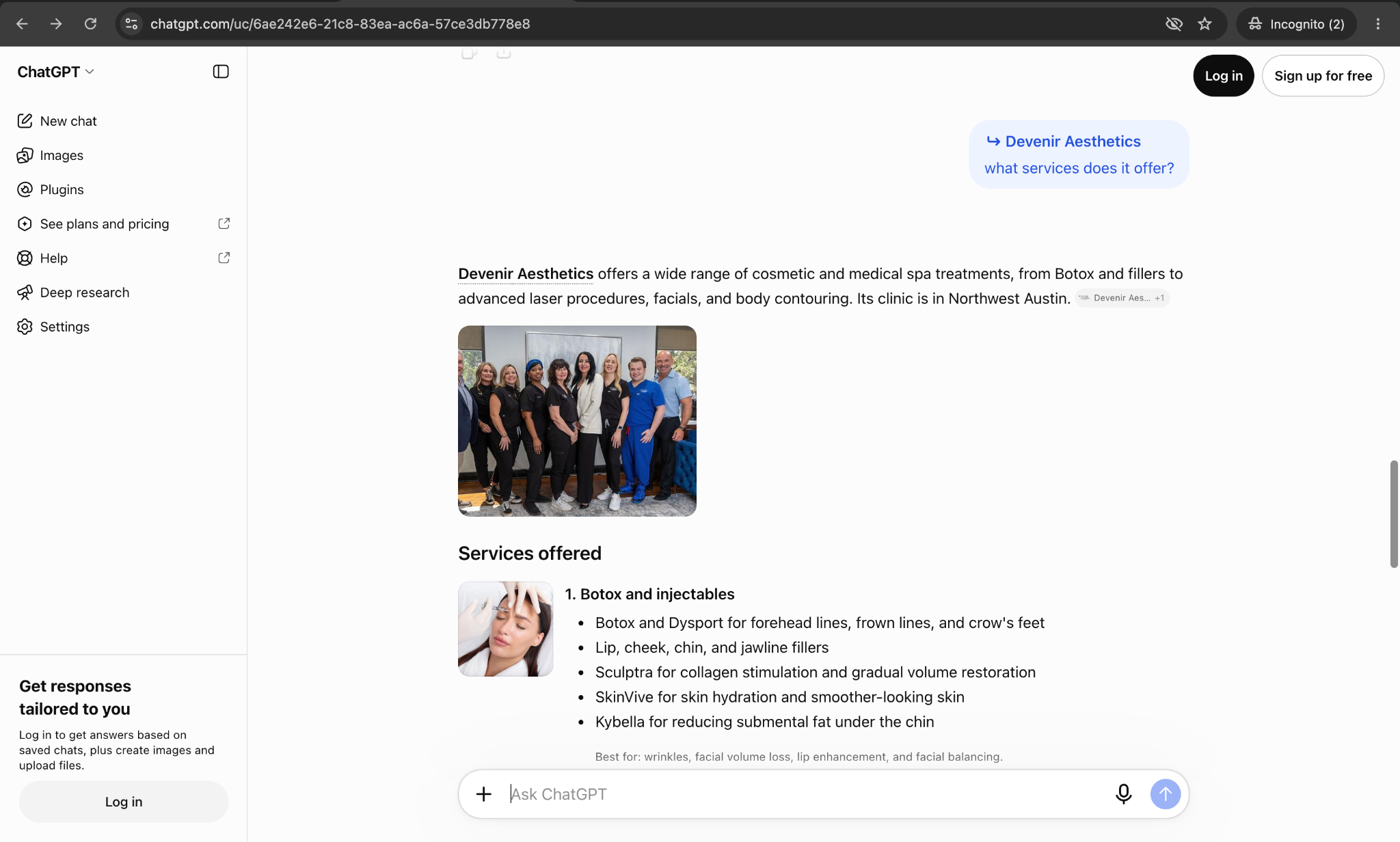
ChatGPT answers within the conversation. We don’t have to navigate the business’s website to find its services.
At the end of the response, an interactive questionnaire helps us explain what we are looking for.
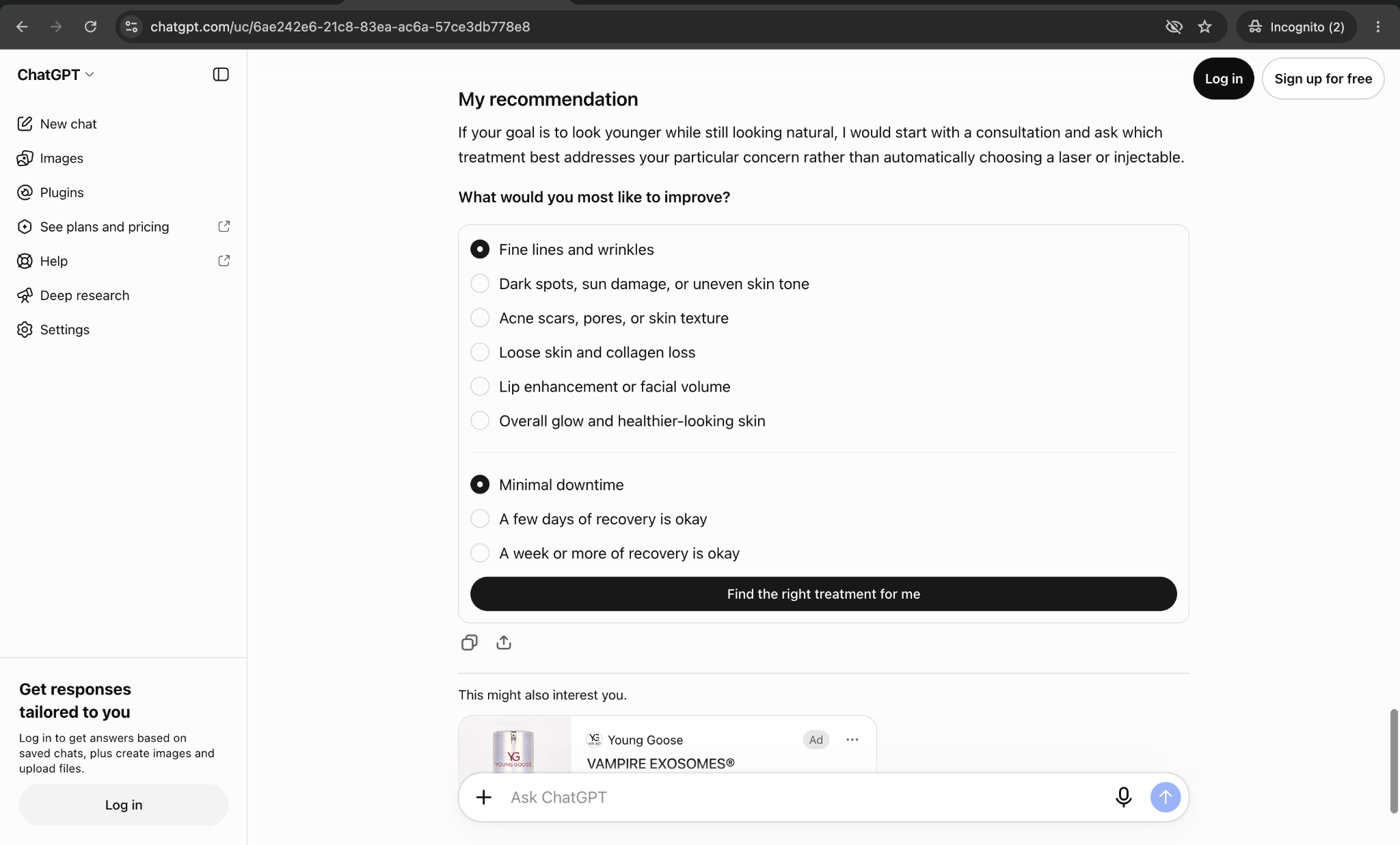
This questionnaire feature was added within the past month. If we were signed into the ChatGPT app, the conversation would also be personalized.
Moving toward a booking
As we answer the questions, ChatGPT recommends a treatment.
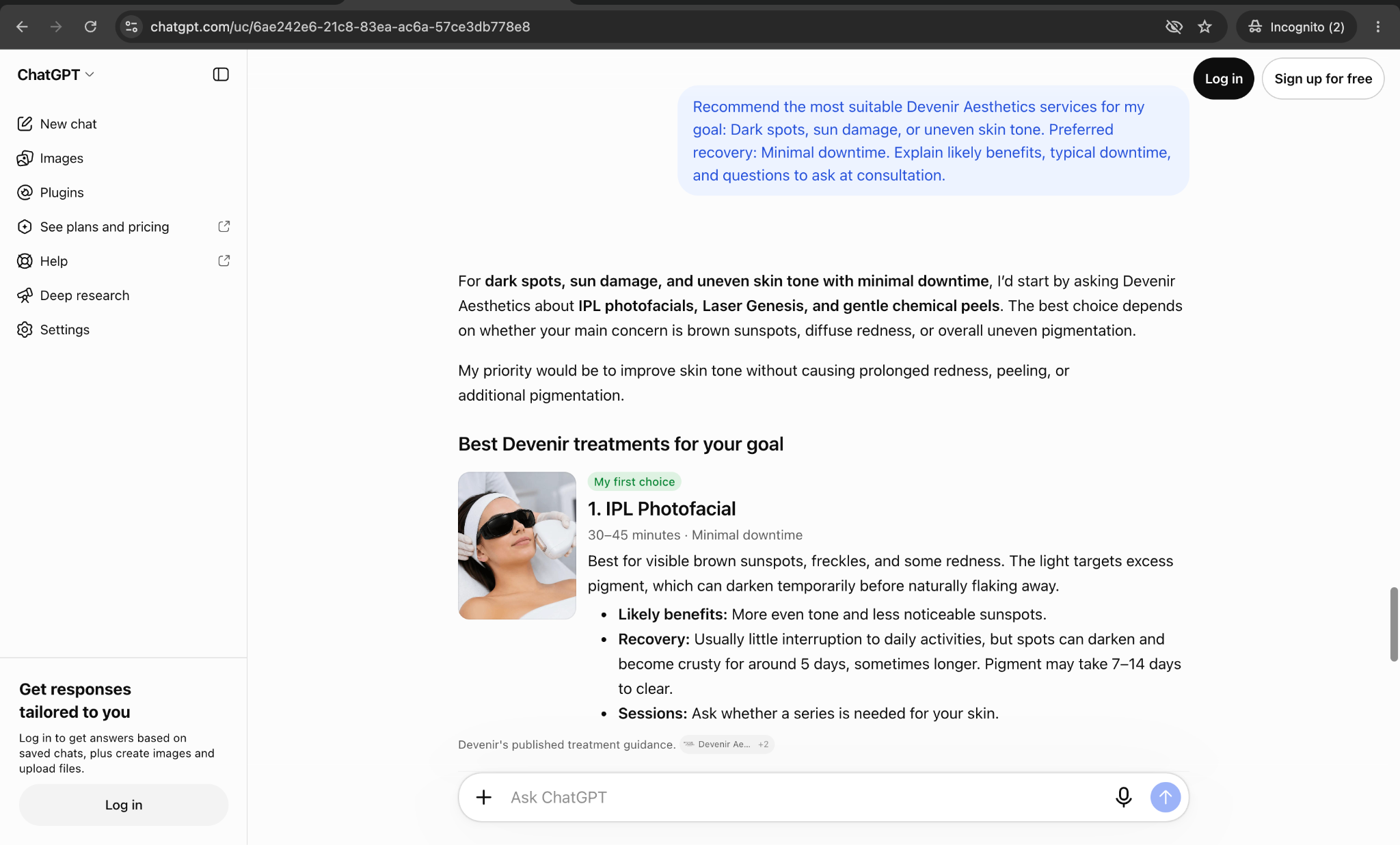
We’ve now moved from searching for a medspa to exploring a specific business and considering a treatment—all within the same conversation.
From here, we can call the business to book an appointment or visit its website to book online.
Client search behavior using Google AI Overview to find a local appointment service business
Google AI Overview lists 5 businesses and shows a comparison table followed by the regular Google Maps. If we click “Show more”, it opens the Google AI mode, where we can chat with Gemini.
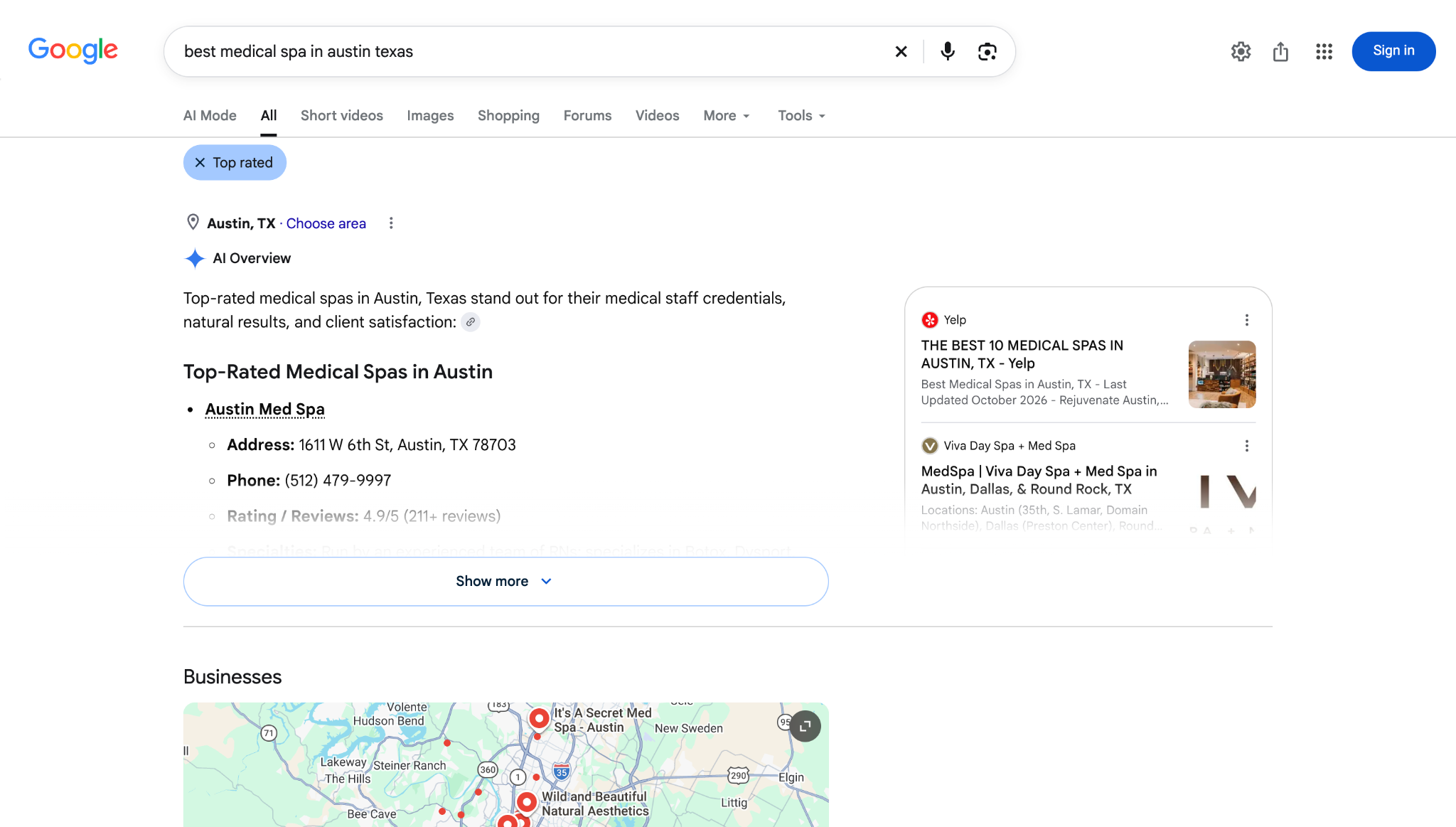
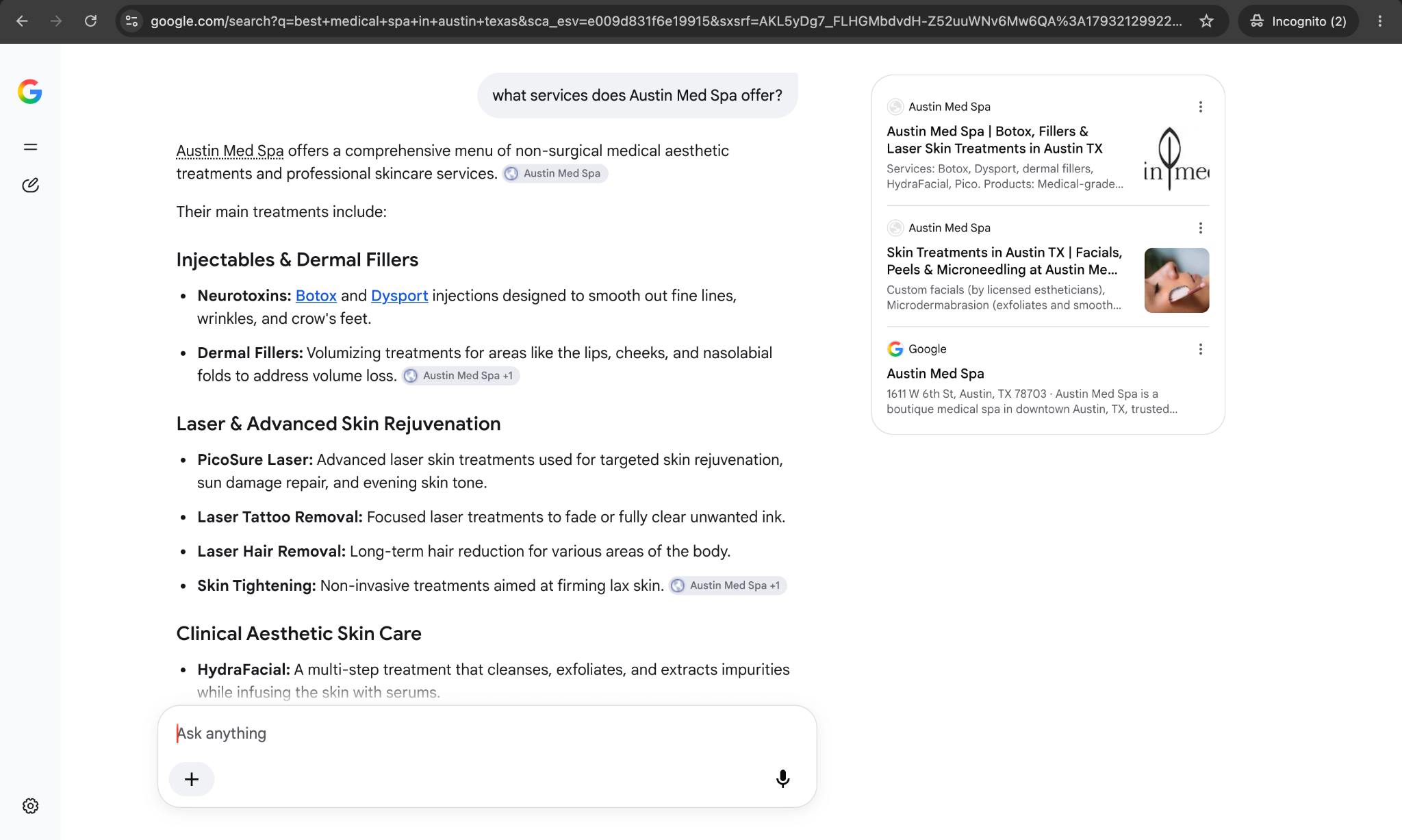
We ask “what services does Austin Med Spa offer?” and Gemini lists the services offered by this business.
We continue with “I am looking for a skin rejuvenation treatment”.
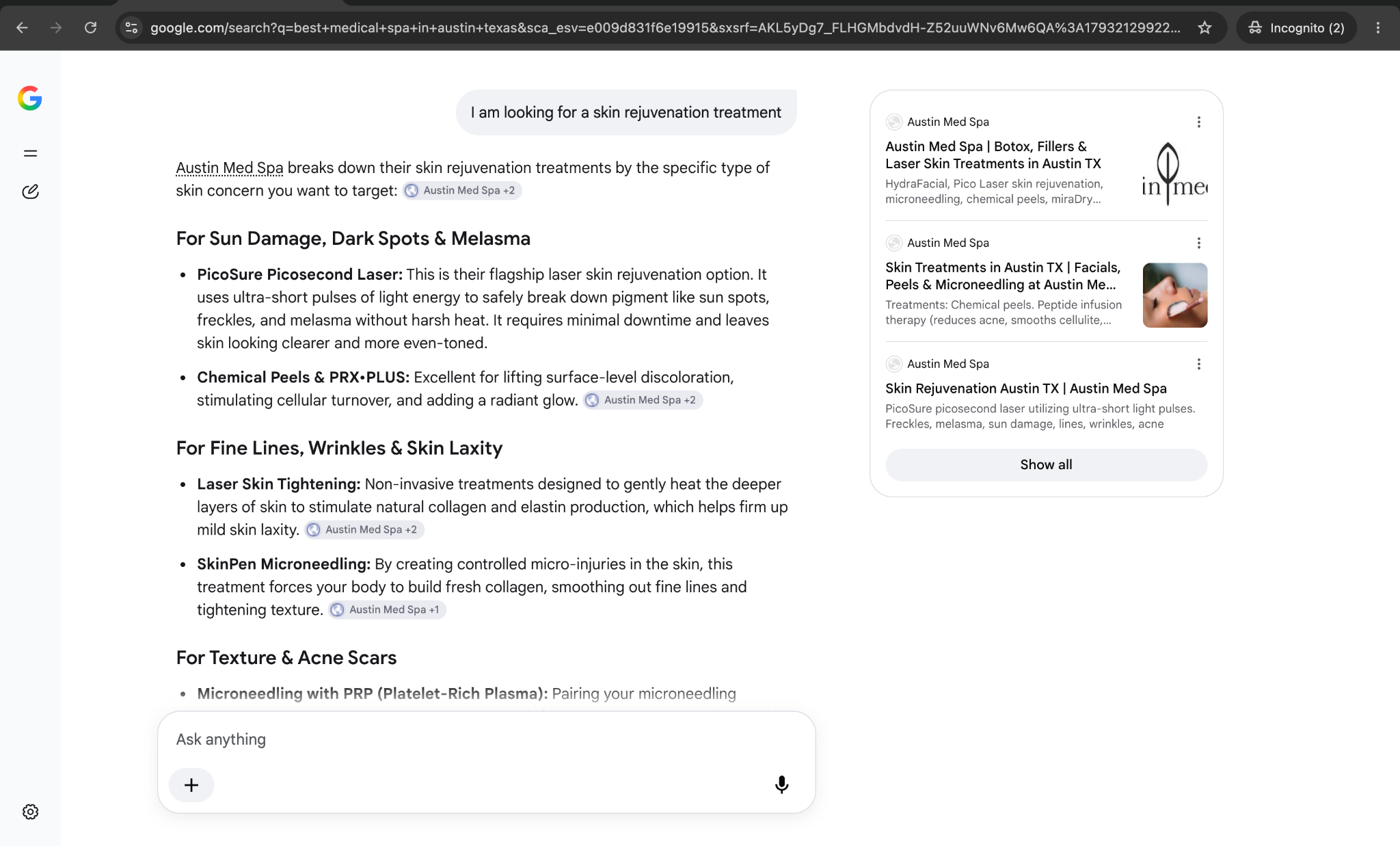
This takes way longer than ChatGPT. We leave the AI mode and go to the website.
What this means for marketing your business
A potential client can learn about your business, explore your services, and become ready to book before visiting your website. Your marketing therefore needs to support the information and first impressions clients encounter in AI answers, Google Maps, and business profiles.
Start by trying the journey yourself using ChatGPT and Google AI Mode: search for your main service in your city, then ask questions about your business. Does it appear? Are its services described accurately? Can a client easily find how to call or book?
From there, focus on three priorities:
- Help people and AI understand your business. Clearly describe your services, specialties, and location on your website, and keep your business information current.
- Strengthen your presence on Google Maps. Keep your Business Profile complete, maintain accurate hours and contact details, and build a useful collection of reviews and photos.
- Make booking easy once the client has decided. Check that your phone number and booking links work wherever clients encounter your business.
Google’s guidance supports these foundations: existing SEO practices remain relevant to its AI features, and complete, accurate business information helps with local visibility.
Your next client may reach your booking page having already researched your business through AI. Another may call without visiting your website at all. Pay attention to what clients learn before they contact you, make the next step easy, and measure calls and bookings alongside website visits.

Join Our Genius Newsletter
Get the latest articles, inspiring how-to’s, and educational workbooks delivered to your inbox.
Written by the SEO and GEO Manager at GlossGenius.
Before AI-assisted search, your clients mainly used Google and other search engines to find local businesses. They entered a search and received a list of results with links they could click. Local searches also included a map (called a local pack) showing nearby businesses.
With AI, your clients can ask a question in an assistant like ChatGPT and receive a generated answer with suggested businesses. They can then ask follow-up questions to compare their options. It is important to understand how your clients use AI to find your business because ChatGPT’s audience is broadening: OpenAI found that message volume grew across all age groups in the first quarter of 2026, with consumers over 35 accounting for an increasing share.
The most important difference is that your clients can skip part of the research they previously did themselves. AI selects which businesses to include and what information to highlight. Consumers may still check websites and reviews, but they can start with a shortlist prepared by the AI.
Let’s look at how this changes the way potential clients search for appointment and service businesses.
More potential clients are using AI to discover local appointment and service businesses
SOCi found that 52% of U.S. consumers reported using AI to find a local business in the previous 30 days in 2026, up from 9% in 2025. Separately, BrightLocal found that 45% used AI for local recommendations in the preceding year. AI answers are becoming another place where prospective clients may first encounter your business.
People may get information about local businesses without visiting a website
Pew Research Center observed clicks on traditional Google results in 8% of visits with an AI summary, compared with 15% without one. Although the study covered all search categories, it suggests that AI answers can influence what people learn before they reach a business’s website.
Customers still check AI recommendations
BrightLocal found that 43% of people who started their latest local-business search with AI subsequently checked Google. Across all respondents, 71% used Google Search during that journey. For business owners, this suggests that reviews, accurate business information, and a clear website still help prospective clients evaluate a recommendation and decide whom to contact.
Let’s compare traditional-search and AI-assisted behaviors.
Traditional search vs search with ChatGPT and Google AI overview
AI can help your clients build a shortlist before they visit individual business websites. Your clients may still check reviews, confirm details, and make the final choice themselves.
Simon Buret de Longagne, SEO and GEO Manager at GlossGenius.
We recreated a client journey looking for a service appointment business and we learned the following:
AI changes where clients do their research and how much they know before visiting a business’s website.
Our test shows that:
1. The client starts with a shortlist selected by AI
Both answers presented five businesses. ChatGPT included a map, while Google added a comparison table and Maps results. The client’s initial options—and first impression of those businesses—come from the information the AI chooses to present.
2. Clients can research a business before opening its website
The business panel, service descriptions, and follow-up answers let clients learn about a business within the AI experience. Someone who eventually visits the website may already have a particular business and treatment in mind.
3. Clients can be ready to book before visiting your website
A client can discover a business, explore its services, and consider a treatment—all within ChatGPT. They may gather everything they need to decide before clicking the Call button or opening the website to book. At that stage, the website may simply be where they complete the booking.
4. Clients can leave the AI conversation when it stops helping and use other search engines
In the illustrated Google journey, the lengthy response prompted you to visit the website. That is a useful observation: clients can move between AI and websites according to which helps them find the information they need. Google also provides an entry into conversational search from its existing results, without requiring the client to start in ChatGPT.
Our takeaway: AI can help clients discover businesses, narrow their choices, and explore services. The next step still depends on what they need—another answer, a website visit, or a phone call.
Test: searching for “best medical spa in austin texas”
Let’s look at the results in ChatGPT and Google AI Overview, then follow the steps a potential customer might take.
Client search behavior using ChatGPT to find a local appointment business
ChatGPT lists 5 businesses and includes a map showing the businesses it recommends.
Opening a business’s details
When we click the first result, a popup opens with more information about the business.
A year ago, this would have been a link taking me to the business’s website. Over the past year, ChatGPT has expanded the information available within the chat, allowing me to learn more before leaving it.
The popup includes several buttons:
- Website links take me to the business’s website.
- Call lets me call the business directly from my phone.
- Follow up takes me back to the chat, where I can ask specific questions about this business.
We could read the information in the popup, decide we want an appointment, and use the Call button to contact the business.
Asking about services
We continue by asking: “What services does this business offer?”
ChatGPT answers within the conversation. We don’t have to navigate the business’s website to find its services.
At the end of the response, an interactive questionnaire helps us explain what we are looking for.
This questionnaire feature was added within the past month. If we were signed into the ChatGPT app, the conversation would also be personalized.
Moving toward a booking
As we answer the questions, ChatGPT recommends a treatment.
We’ve now moved from searching for a medspa to exploring a specific business and considering a treatment—all within the same conversation.
From here, we can call the business to book an appointment or visit its website to book online.
Client search behavior using Google AI Overview to find a local appointment service business
Google AI Overview lists 5 businesses and shows a comparison table followed by the regular Google Maps. If we click “Show more”, it opens the Google AI mode, where we can chat with Gemini.
We ask “what services does Austin Med Spa offer?” and Gemini lists the services offered by this business.
We continue with “I am looking for a skin rejuvenation treatment”.
This takes way longer than ChatGPT. We leave the AI mode and go to the website.
What this means for marketing your business
A potential client can learn about your business, explore your services, and become ready to book before visiting your website. Your marketing therefore needs to support the information and first impressions clients encounter in AI answers, Google Maps, and business profiles.
Start by trying the journey yourself using ChatGPT and Google AI Mode: search for your main service in your city, then ask questions about your business. Does it appear? Are its services described accurately? Can a client easily find how to call or book?
From there, focus on three priorities:
- Help people and AI understand your business. Clearly describe your services, specialties, and location on your website, and keep your business information current.
- Strengthen your presence on Google Maps. Keep your Business Profile complete, maintain accurate hours and contact details, and build a useful collection of reviews and photos.
- Make booking easy once the client has decided. Check that your phone number and booking links work wherever clients encounter your business.
Google’s guidance supports these foundations: existing SEO practices remain relevant to its AI features, and complete, accurate business information helps with local visibility.
Your next client may reach your booking page having already researched your business through AI. Another may call without visiting your website at all. Pay attention to what clients learn before they contact you, make the next step easy, and measure calls and bookings alongside website visits.
Download Now
Join Our Genius Newsletter
Get the latest articles, inspiring how-to’s, and educational workbooks delivered to your inbox.